London is the deadline, not the itinerary
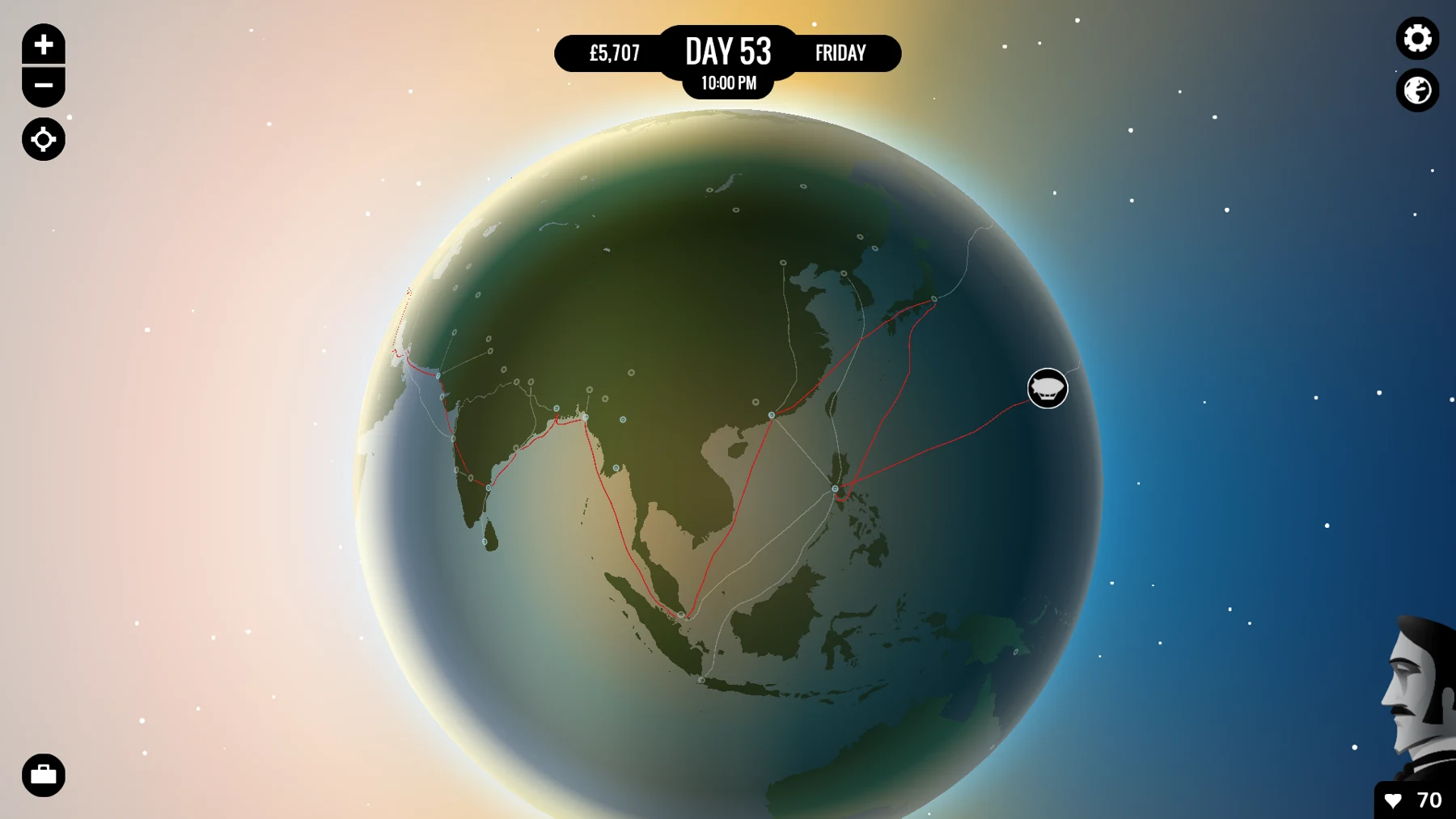
In 80 Days, Passepartout manages Phileas Fogg’s journey around an alternate-history 1872. The aim is to return to London within the famous eighty-day budget, but inkle deliberately expanded the transport network beyond the route available to Verne’s characters. The trip is a set of choices between connections, not a requirement to reproduce the novel. Developer source Developer source
The developer’s examples make that geography tangible: Paris to Istanbul by Orient Express, Istanbul to Beirut by balloon, and Beirut to Alexandria by steamer. Another branch links Amsterdam with Kristiania, now Oslo, by hydrofoil. These are examples from inkle’s design account, not a recommended fastest itinerary or a real historical timetable. Developer source
The earlier departure has a price
The published game description names three resources to balance: Fogg’s health, money and time. Transport departs and arrives against an in-game clock. Paying for an earlier departure is possible, but so is running out of money. A connection that saves hours can therefore weaken the next part of the journey. Developer source
That tradeoff is the route-planning problem at the heart of the premise. Waiting spends time; accelerating a departure spends cash. The map alone cannot settle which is better, because the state of the travelling party changes the value of the same connection. This is an interpretation of the stated systems, rather than a claim about a particular played route.
Luggage is part of the transport problem
Items can be traded for profit, and equipment can be collected for expected conditions. The same official description warns that too much luggage slows travel. A bag can therefore hold something useful for a later leg and still make the immediate journey less efficient. There is no universal instruction to buy everything that looks helpful. Developer source
The interesting choice is what to carry across the next connection. Trade goods, useful equipment and a manageable load pull in different directions. Exact allowances and fares belong to the game’s individual services; the general system is enough to explain why managing the bag is also managing the route.
An itinerary with room for encounters
Journeys and cities contain interactive choices that can speed up or disrupt the plan. Airships, submarines, mechanical camels and steam trains give the fictional nineteenth century its range of possibilities. The attraction is a world in which a new departure is also a new story opening, while London’s deadline keeps every detour from being free. Developer source
Sources & further reading
Sources, dates, or details to query? Read our editorial approach.