A vessel built for a changed world
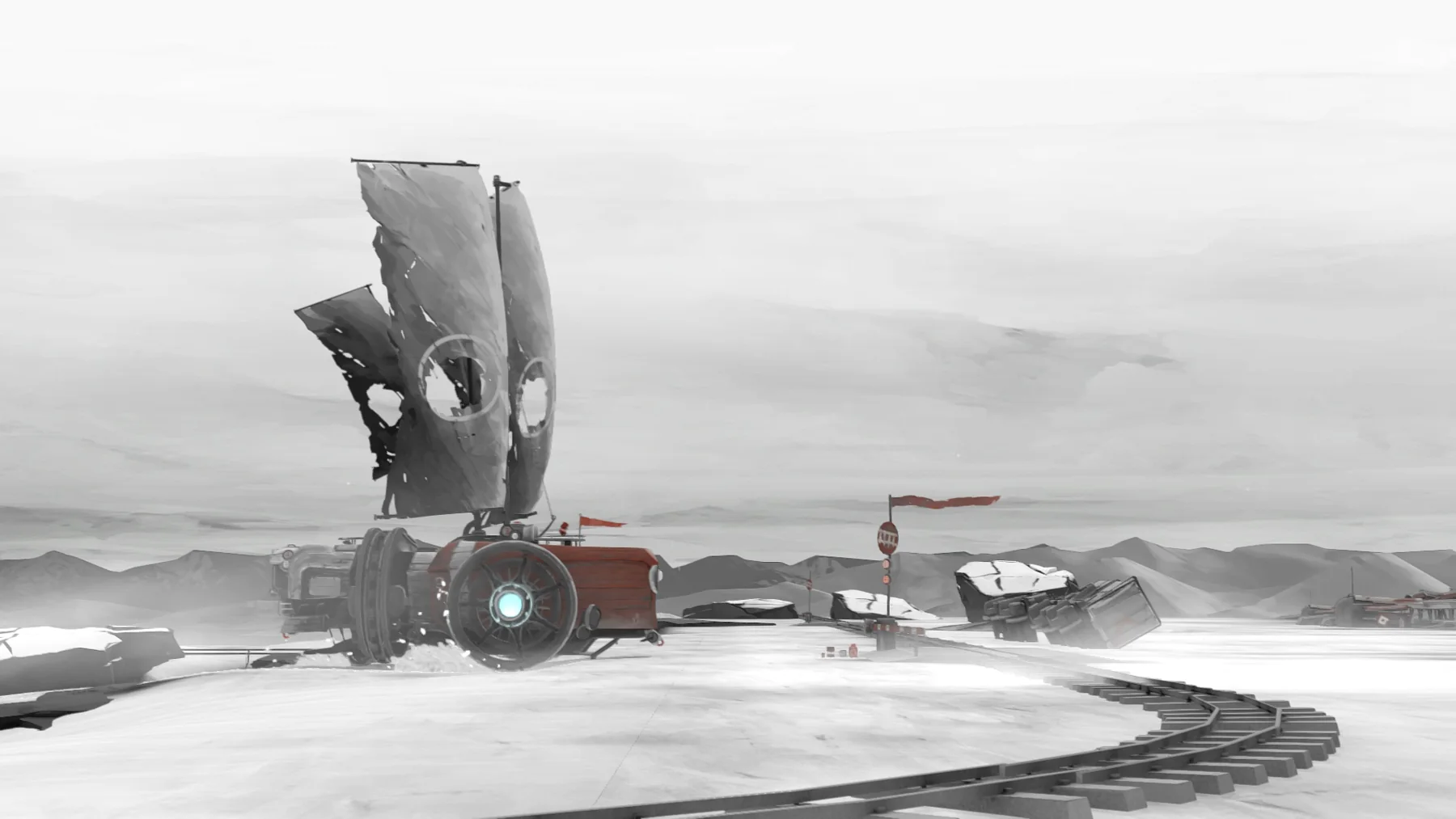
FAR: Lone Sails begins from a transformed landscape: the sea has dried out, leaving a broad seabed for a unique vehicle to cross. The vessel is described as train-like, or as a hybrid of ship and train, but it travels over land rather than across an existing ocean. Its sails can use wind, while fuel, maintenance, and upgrades keep the vehicle moving. Official Steam description Official press kit Developer launch feature
That combination makes movement an ongoing practical concern. Weather and roadblocks shape the route, and the player maintains and upgrades the vessel while crossing the exposed basin. The journey’s central activity is keeping this unusual machine going through a world whose old infrastructure and remains testify to a departed civilization. Official Steam description
The seabed as a record
The drained sea contains submarines and supertankers. Their presence makes the terrain read as a former maritime environment, now crossed by a land vehicle; the stranded craft are relics of the world before its waters vanished. The scale of these remains gives the route a concrete history without turning it into a conventional sequence of combat encounters. Official Steam description Official press kit
Former island settlements survive as ruins on hills. As the journey passes from seabed to elevated remnants of habitation, the setting changes from open crossing to evidence of places where people once lived. Buildings and relics sit alongside obstacles and salvage, giving the player reasons to engage with the route’s details as well as its forward movement. Official Steam description Official press kit
Keep the hybrid moving
Fuel, maintenance, upgrades, and salvage give the crossing its practical texture. Wind offers another source of motion through the vessel’s sails, while weather and roadblocks can alter what progress requires. These elements support a focused travel loop: care for the vehicle, respond to what blocks or powers it, and continue across the dried-out sea. The game does not present itself as a realistic navigation or engineering simulator. Official Steam description Official press kit
Okomotive founder Don Schmocker described the vehicle as a hybrid of ship and train and the setting as an ocean turned desert. He also said the studio deliberately allows time to observe scenery between obstacles. That pacing gives the ruins and ship graveyards room to register as parts of a changing landscape, rather than just background between mechanical tasks. Developer launch feature
A crossing with an unanswered horizon
The route’s landmarks offer pieces of a vanished civilization, while its larger destination remains a question. Submarines and supertankers establish what the dried seabed used to be; hilltop ruins show that former islands held settlements. Salvage and obstructions bring those traces into the act of travel, so exploration comes from crossing and tending a vehicle through an altered world. Official press kit
Schmocker named Theo Jansen’s Strandbeest and films including The Straight Story and Mad Max among influences on the original concept. Those references describe creative inspiration, not literal machinery or locations in the game. The experience itself is grounded in its own train-like vessel, wind-powered sails, and long passage across the exposed sea floor. Developer launch feature
Sources & further reading
Sources, dates, or details to query? Read our editorial approach.