A landscape with a distant aim
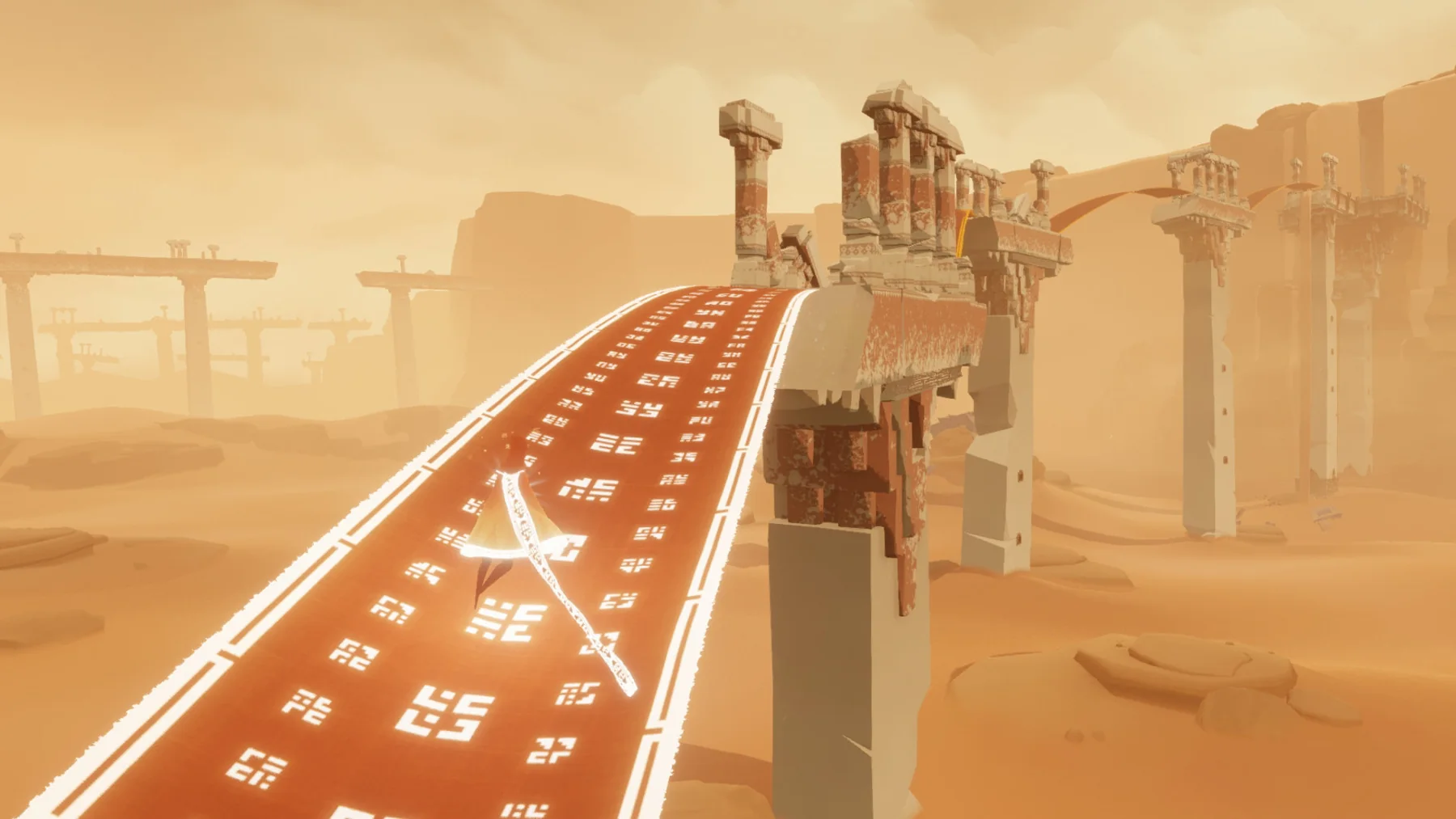
Journey gives its desert a clear visual direction: an anonymous traveller moves toward a looming mountaintop. The land includes ancient ruins and broad expanses of sand, with traces of a forgotten civilization whose identity and history remain for discovery. The destination supplies orientation without turning the passage into a conventional combat objective. Official game website
That structure makes the world feel legible at a distance while leaving its meaning open. The mountain is the central point of reference; the ruins and sand are the terrain through which the traveller gradually approaches it. Official game website
Movement changes the view
The official description emphasizes soaring above ruins and gliding over sand. These movement modes make elevation and open ground matter to how the landscape is read: the same desert is encountered from above its built remains and across its broad sandy stretches. Official Steam description
Creative director Jenova Chen discussed sand surfing, cloth-assisted flight, and a calling action that can communicate with another player as well as interact with cloth. Those design intentions help explain why movement and simple signals belong together in the game’s exploration language. Jenova Chen: design interview
Company without obligation
The passage can be experienced alone or with a companion. Players may encounter another anonymous traveller along the way, but the social premise does not make company mandatory. That flexibility lets the mountain remain the shared destination even when the journey is solitary. Official Steam description Official game website
Chen compared meeting another traveller to crossing paths with someone on a mountain hike: continuing together is optional, and the game should also work alone. The interview describes removing lobbies and voice chat, supporting an encounter that does not depend on a conventional social hub or spoken exchange. Jenova Chen: design interview
Discovery rather than a checklist
The ruins are evidence of a civilization, not a supplied history lesson. Their role is to invite interpretation as the traveller moves through the desert, while the game’s broad emphasis stays on discovering the world. The sources establish no fixed route or catalogue of hidden locations, so the meaningful structure is the journey between terrain and mountain. Official Steam description Official game website
That combination gives Journey its particular travel rhythm: the mountain offers a persistent bearing, the ruins suggest a past, and gliding or travelling beside a companion changes how the crossing feels without changing its destination. Official game website Jenova Chen: design interview
Sources & further reading
Sources, dates, or details to query? Read our editorial approach.